Medical Software Development: A Step-By-Step Guide
Pondering over medical software development, but all at sea while ascertaining where to begin? Get stopped by this guide consisting of extensive information about medical software development!


Tech evolution has influenced most of the sectors, and healthcare isn’t untouched by it. Medical software development has transformed the way procedures used to be conducted in the healthcare industry a few years back. Through this article, we’re to learn everything relating to medical software, its kind, features, and benefits, along with the process for development.
You may know that the size of the healthcare software as a service market worldwide was anticipated to reach $28.66 billion dated back to the year 2022 and is expected to reach up to $77.43 billion by the year 2032 (at a CAGR) of 10.5% during the period 2023 to 2032.
You’re thinking, why is medical software development that popular, aren’t you? There are various reasons; for instance, it enriches the quality of medical business management medical care while ensuring a better reach to patients in a more accessible manner.
Codzgarage is a custom software development companyproviding end-to-end assistance to businesses on the lookout for software development services. Contact us to discuss your project!
Building medical software allows businesses not only frequent and efficient workflow but also enhances benefits in terms of the services from medical workers. Hence, it’s essential for organizations to know about medical software development and leverage the benefits from it.
Let’s read between the lines!
What is Medical Software?
Medical software is a kind of software in the healthcare industry that enhances different medical procedures, including pharmacology, cardiology, and the like. In general, medical software assists across health environments to conduct tasks relating to medical practices, medical record management, quality control, and so on. Besides, medical software solutions are also capable of serving as a medical device for comprehensive medical necessities.
In the recent few years, the need for medical software embedded with appropriate features & functionalities, as well as the ones with simple features, have gained in demand. Now, the majority of healthcare professionals tend to move towards medical software development to streamline procedures in their organizations. There are various healthcare app development trends & technologies following which one can build a quality application for healthcare organizations.
What are the Benefits of Medical Software Development?
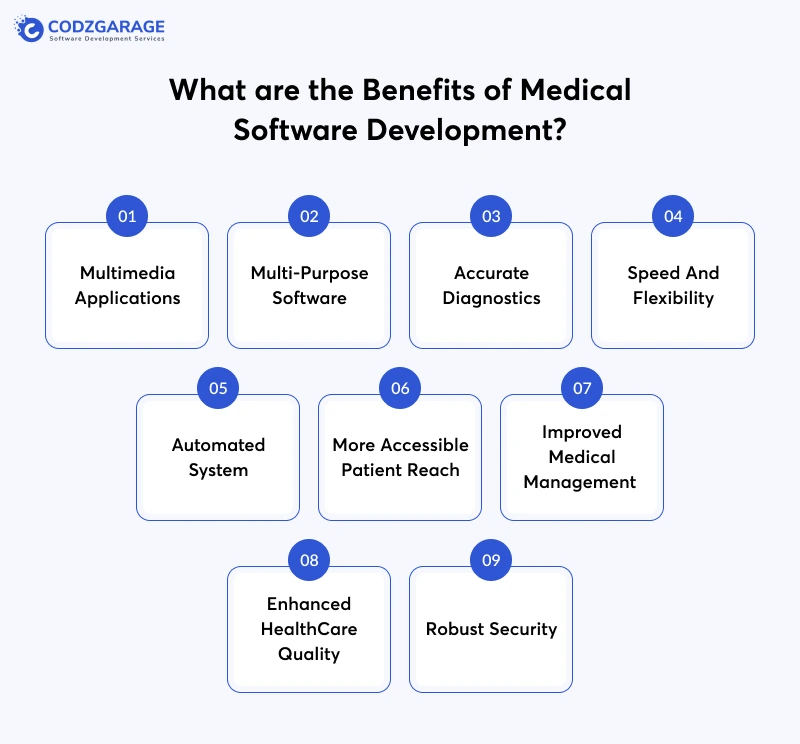
There are plenty of benefits to developing medical software solutions. This includes streamlined speed, enhanced security, cost-effective services, and the like. However, the benefits can be plenty; the following are some of the benefits of medical software development that you should have a look at!
- Multimedia Applications— With medical software development, you get multimedia applications. These apps tend to make treatment easier and more comfortable. Apart from that, the distraction created by reading on a computer screen is avoided by these high-performance applications.
- Multi-Purpose Software— You can now conduct various tasks with these multi-purpose medical software solutions. Some of them may be, for instance, scheduling patients and organizing their details to manage the flow of your services while curtailing the overall cost.
- Accurate Diagnostics— Medical software solutions offer diagnosis with more accuracy than traditional methods. With this method, doctors can receive the whiteboard images and diagnoses, aimed at instantly seeing X-rays, tests, and the like with no need for additional instruments.
- Speed And Flexibility— Enhanced speed of the time at which a patient receives treatments is also mitigated with medical software systems. Using this system, experts and medical professionals conduct intense analysis of the result with real-time feedback provided to the clinicians in a matter of seconds.
- Automated System— Automated systems used to manage medical records and email notifications are one of the benefits of medical software solutions. It allows the software to get whatever it needs to communicate with other systems. It’s capable of running on various platforms, including macOS, Linux, Windows, iOS, and Android.
- More Accessible Patient Reach— There comes a moment when health professionals encounter tough times reaching out to patients and monitoring progress. With medical software development, it’s no longer the issue. The medical portals, apps, and other solutions offer a suitable way to get in virtual conduct with patients.
- Improved Medical Management— Medical software solutions ensure higher feasibility of reliable data accumulation, secure storage of the collected data, and efficient management. As a result, you get financial efficiency with the mitigated expense of medical proceedings.
- Enhanced HealthCare Quality— Doctors, as well as other medical professionals, spend a huge chunk of time doing paperwork. They experience tough times when they need to spend long hours offering care to patients. With medical software, doctors can have versatile solutions and seamless experiences while conducting medical activities.
- Robust Security— With the robust security advancement of medical software solutions, the healthcare industry is capable of transmitting, storing, and retrieving web data the way it would before. Thanks to these enhancements, a multidimensional verification process can be used with these security arrangements.
The above-mentioned pointers suggest the benefits you can embrace by building medical software applications. So now, you should explore, select, and get engaged with a service medical app development company to create your app. If you don’t know how to do it, you can flip our previously published software development outsourcing guide to expand your knowledge.
Types of Medical Software Solutions
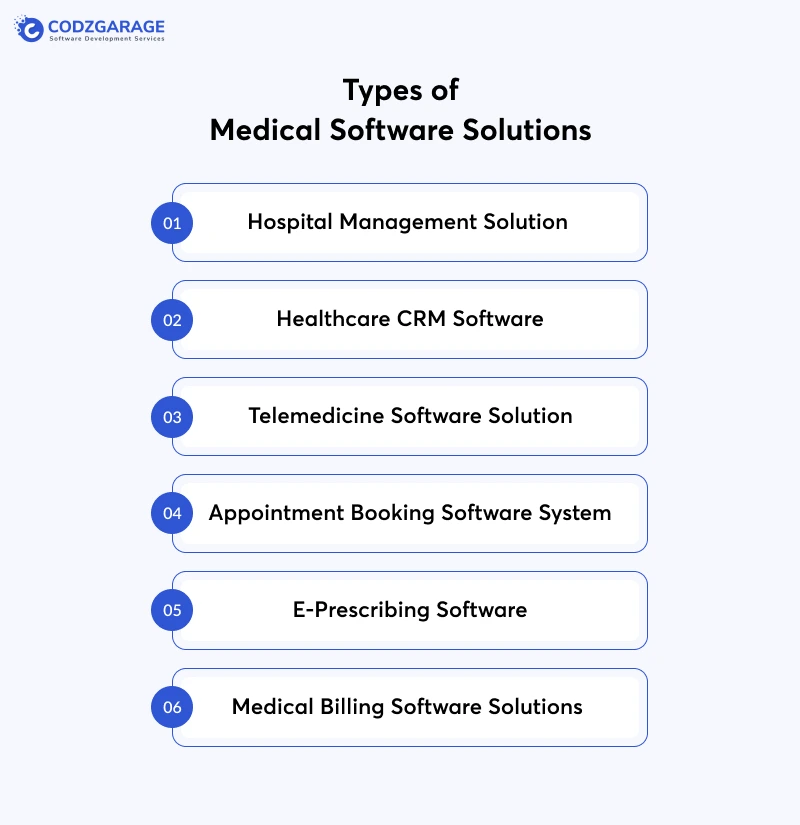
Having known the benefits of medical software solutions, you’re more likely to embark on building one, but before that, you should know their types, too. So, let’s do that without further ado!
Hospital Management Solution
Administrators in hospitals tend to have extremely tiring jobs that involve investing a huge chunk of time and effort. Thanks to the Hospital Management software, it makes that daunting procedure a completely easy affair. The system provides users with user-friendly tools and solutions to allow them to plan better and schedule effectively, some of which are given below:
- Daily notifications for patients.
- Text messaging for patients.
- Image or file-sharing option.
- Emergency information when required.
- Security enhancements, and the like.
Healthcare CRM Software
You probably know that CRM stands for customer relationship management. The terms “healthcare CRM, and “telehealth software” are used interchangeably. Healthcare CRM software is a kind of software that’s used by hospitals to manage the services they provide to patients.
Medical organizations employ Healthcare CRM software solutions in order to boost patient engagement, enhance patient access, and improve virtual treatment. Service providers are more likely to deliver online telemedicine services to patients with ease using this system— as they have well-designed Healthcare CRM software solutions.
Telemedicine Software Solution
Next up, we’ve Telemedicine software to discuss in this article. Hospitals nowadays tend to make use of this solution to leverage the experience of digital transformation in healthcare. The system enables medical professionals who lack appropriate space to accommodate their medical staff to handle their patients sufficiently.
The ultimate aim of building Telemedicine Software is to help hospitals overcome the tiresome obstacles they encounter while hiring and maintaining staff. The system offers them an efficient way to provide their patients with a comprehensive range of solutions via remote access. Moreover, it’s convenient to use and ensures timeless communication among medical professionals, including doctors, nurses, and patients, with no limitations.
Appointment Booking Software System
An appointment booking system is a kind of software that enables patients to book appointments in advance while also giving them a detailed itinerary and contact information needed. Besides, it also enables doctors to see the available appointments that are scheduled for them, along with comprehensive information in respect of appointments.
The Appointment booking software assists hospitals in making schedules, thereby freeing them to manage the same on their own.
E-Prescribing Software
The e-prescribing system is a kind of medical software used by healthcare professionals for sending prescriptions to pharmacies as well as prescription fulfillment facilities. The system also enables pharmaceutical staff to receive messages and comments from the medical staff.
Thanks to a system like e-prescribing software, both parties are aware of the necessary prescriptions and requirements. Apart from these, the information is completely safe while being processed.
Medical Billing Software Solutions
This is another type of medical software. The medical billing software isn’t strange but is similar to other systems that keep track of the billing information. Medical professionals, using medical billing software, can keep track of invoices, recurring expenses, past payments, and the like.
The system makes it way more convenient for hospitals to perform their jobs so that the organization can remain in excellent financial condition.
Essential Features of Medical Software Development
After knowing the benefits and types of medical software development, it’s time to move further and learn the essential features of medical software development. Have a look at the pointers below, gesturing to the features of medical software solutions!
- Document Management— Medical software solutions come embedded with document management competencies, which involve the capability to manage and retrieve information relating to patients from a variety of supporting documents, for instance, prescriptions and lab results.
- Online Data Sharing— The enterprise medical software comes embellished with the capability to share data across institutions, for example, clients and hospitals that are located in the same geographical location.
- Mobile Computing— Mobile computing is gaining traction day in and day out. This is because, with the advancement of mobile phones, medical software is more likely to be accessed from anywhere with ease.
- Tracking System— Features to keep track of a patient’s vital signs and conditions must be the priority of any medical software, and medical software systems do so. It helps you track pulse, heart rate, blood pressure, blood sugar level, calorie intake, and the like. Having apps with such amazing features tends to boost the user experience, too.
- E-Prescribing— Besides many features, there’s a new feature that has been introduced recently in the medical software development industry, which is e-prescribing. The very system enables physicians and other prescribers to conveniently send prescriptions through the web right to the patient’s preferred pharmacies.
- Insurance Processing— Medical software solutions are capable of processing insurance claims as per the requirements of the healthcare provider’s contract.
What’s The Process of Medical Software Development?
Now that we’ve assessed most of the aspects, you’re more likely to think of developing medical software. Yes, you can do that! All you need to do is explore some of the best software development tools to use. But, before that, you should explore the process of medical software development, so let’s do it first!
Know Your Target Audience & Market
Before you embark on the journey to build medical management software, make sure you’re aware of the market you target and its needs. This is because if you know your target audience and their preferences, you’ll be more likely to end up having a clear vision, thereby developing software that meets your as well as your client’s expectations.
Gather Essential Information Relating to Your Product Idea
Accumulating information is of utmost significance; hence, you must consider having comprehensive data needed for your app development. You should make sure you have all the information needed to create medical software, for instance, EMR software and the like.
Consider Designing A Prototype
Design and prototype are essential facets of medical software development. A prototype is an interactive working model showing how a product looks after its being developed. Make sure that your prototype includes a wireframe, making use of a computer interface competent to enable users to interact with the product. There are various reasons why prototyping is important, and some of them are mentioned below:
- It’s an excellent way to test a product prior to its creation.
- Prototyping makes it feasible to collect feedback and make sure you’re going on the right track, with no need to invest resources in development initially.
- You can measure and make changes to your project intending to circumvent glitches rather than waiting until the very end of the project accomplishment.
Create A Final Prototype
Once you’ve designed your project with prototyping tools and technologies, you should consider creating a final prototype for medical application development. Being a medical software developer, you’re obliged to know and understand the overall procedure of developing medical software solutions that function well, meet all the expectations of the clients, and keep up with the changes in technologies. Keep in mind that having clear ideas about how your software will look when it gets completed is the essence of prototyping.
Develop Your Software By Creating Codes
It’s a fact, however, that developing software takes time and effort, but that never means that you should spend months after months writing codes only. You can integrate third-party apps or development kits into your project that help you create the software in a matter of a few hours of work. Following this method allows you to end up building medical software in a short span of time.
Software Delivery To The Clients
Project delivery is the last step of your entire software development effort. You must think of software delivery with all the needed updates, for instance, documentation and so on. In case you’re in a rush for software delivery, ensure that you offer appropriate time to the users to test the same and provide you with feedback.
Want to Know In-House vs Offshore Software Developer Cost?
Explore More!Signing Off….!
That’s pretty much about medical software development! We assessed various aspects relating to medical software creation, including its kind, the benefits, the types of medical software systems, features, and the process followed to build one. Since we’ve covered all the aspects related to medical software development, we hope you have no questions that remain unanswered. Then, why wait? Get connected to a medical software developer and get your software built in no time!

Want
build medical software?Our expertise!
- 11+ years of experience
- Excellent expertise
- Timely delivery
Related Blog
April 16, 2026
-
 965
965
 Kevin Bhut
 Browse through this in-depth guide and learn why and how to modernize your legacy CRM system | Explore more!...

December 25, 2025
-
1424
Manthan Bhanvadiya Software development can be performed in many ways. It may be in-house development, software outsourcing, or by hiring a dedicated development team....

November 26, 2025
-
1796
Kevin Bhut Since the concept of a “serverless” system is gaining traction, you’re likely to develop curiosity in this regard. But, it isn’t a big deal to understand the reasons for it. ...

June 23, 2025
-
1946
Paresh Kapuriya An informative guide letting you know how to handle hidden app development costs to circumvent budget overruns! ...

April 16, 2025
-
2603
Kevin Bhut Users’ requirement changes from time to time, and what’s worthwhile today may not be that relevant in the future as well, and that’s where UI/UX app...