EHR Software Development: An End-to-End Assessment
Are you all over the map about EHR systems? If yes, browse through this very guide to be aware of Electronic Health Record (EHR) software development!


If you have been to a doctor’s clinic recently, you may have found the doctor viewing or putting in data relating to your health on a computer. Pondering why is it so? It may be because they’re updating or reading records regarding your health on the EMR system. You don’t know about it, are you? That’s where this article comes in. It involves a complete assessment of Electronic Health Record (EHR) software development, including its kind, features, benefits and the like!
The exponential tech revolution in recent years has had an immense influence across industries, and healthcare isn’t an exception. Now, a system like EHR (Electronic Healthcare Record) enables patients as well as hospitals to simplify procedures the way they used to conduct previously.
With this system, not only can the patients have access to the next level of treatments, but also healthcare professionals are able to use efficient tools to enhance patient care and provide better services while saving a huge chunk of time on both sides.
Codzgarage is a leading custom software development company offering innovative software solutions to businesses of all sizes. Contact us to discuss your project!
However, there may be plenty of reasons why the healthcare industry is adopting the EHR system; this guide consists of some essential ones. It’ll drive you through a complete set of information on Electronic Health Record (EHR) software development.
Let’s drill down!
What’s An EHR (Electronic Healthcare Record) System?
The EHR is an utterly digitized software system that consists of an extensive range of information relating to a patient’s health, including:
- Allergy informations
- Patient demographics
- Vital signs
- Medical histories
- Medication hystories
- Diagnoses
- Progress notes
- Lab test results
- Insurance information, etc.
The EHR is a kind of summary of a patient’s health records that are accumulated, stored, and shared across medical officials using a structured computer system. Every authorized individual involved in the patient’s treatment, for instance, labs, nursing homes, physicians, pharmacies, patients, and state registries, can simply share information with the EHR system.
The information contained in EHR software is likely to be anything from diagnoses, prescriptions, and lab reports to details relating to checkups and the like. The EHR system offers a centralized platform enabling healthcare professionals to ensure nothing falls through the cracks. The system assists professionals in mitigating the chances of making mistakes while making the procedure flawless and seamless.
Types of Electronic Health Record (EHR) Software Systems
If we look from a technical point of view, the EHR software systems come in a variety of forms. They not only come in different kinds but also have different kinds of use cases across the departments in the healthcare industry. Following are some of the well-known Electronic Health Record (EHR) systems you should have a look at!
- Web-Based EHR Systems— These are the kinds of EHRs that you can access through a web browser. This one proves to be convenient if you’ve various locations or professionals in need of remote access.
- Mobile EHR Systems— The mobile-friendliness has become a norm when it comes to software solutions in the modern era. As the name suggests, users can conveniently access mobile EHRs using their smartphones and tablets.
- On-Premises EHR Systems— This is another kind of electronic healthcare record software with which you install data locally within your infrastructure. It lets you get excellent control over data.
- Cloud-Based EHR Systems— Users can conveniently host cloud-based EHR systems on remote servers with which healthcare professionals can access patient’s data irrespective of time and place.
- Personal Health Records— Last but not least, PHRs (Personal Health Records) are aimed at assisting patients in tracking health information, for instance, medications, tests, appointments and the like.
What Are The Features of An EHR System?
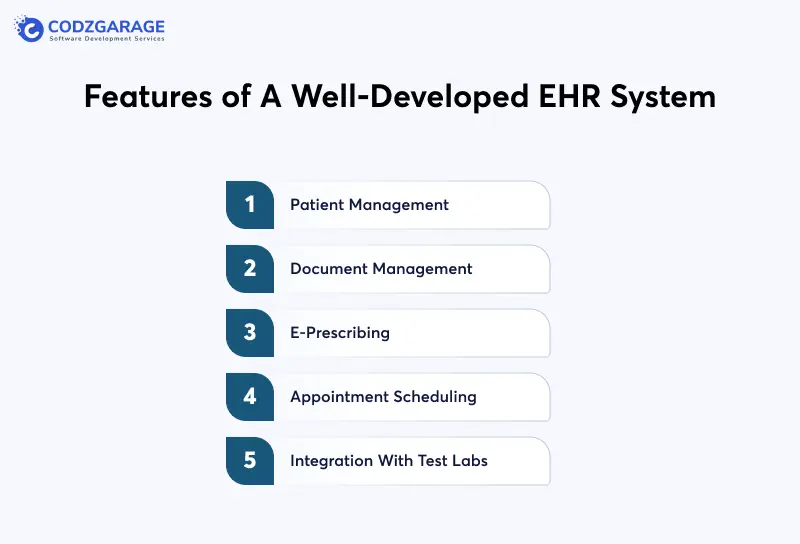
The full-fledged features and functionalities are one of the reasons why businesses prefer custom software development like EHR systems. Every Electronic Health Record (EHR) is created based on an individual’s needs and necessities; however, some important features come embedded with most of the systems. Have a look at those features of the EHRs!
Patient Management
The system contains the patient’s data, including name, address, test results, diagnosis, prescribed medicine, and the like, to provide information that gives insights into a patient’s health condition.
Document Management
The preliminary purpose of the EHR system is to ensure quality care for the patient by offering easy-to-use tools for documentation. With this system, it’s convenient for doctors to upload documents in a variety of formats, for instance, image, textual, and DICOM (it’s the image format for CT and MRT images).
E-Prescribing
This feature allows doctors to prescribe medicines to patients irrespective of the location while accessing their medical data to ensure there’s no incompatibility relating to the drug. Moreover, patients can conveniently keep track of their medical history.
Appointment Scheduling
The electronic health record software enables patients to schedule real-time appointments with their doctors. Moreover, the doctors have a dashboard where they can view the appointments as well as the patient’s details.
Integration With Test Labs
The EHR integration with data labs ensures streamlined data exchange, resulting in rapid decision-making. The test results get sent to the app directly, making it convenient for patients as well as doctors to access them timelessly.
What Are the Benefits of EHR System Development?
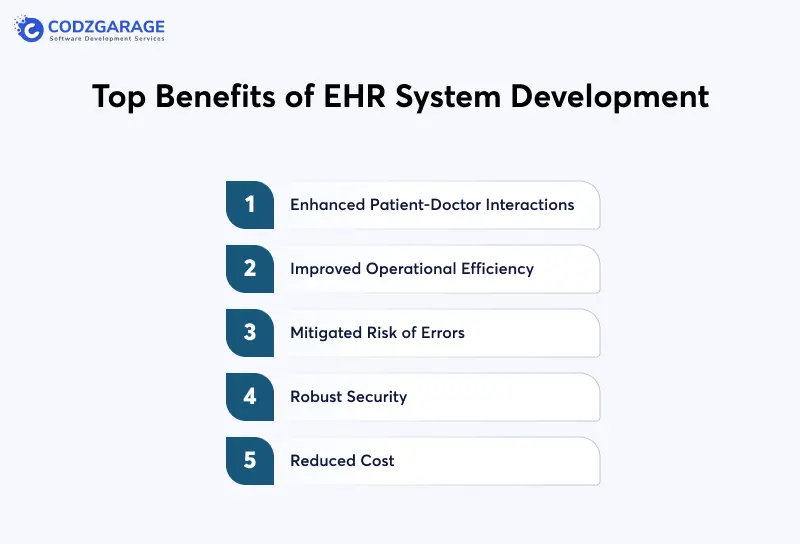
Now that we’ve become aware of the basics of Electronic Health Record (EHR) systems, including their kind and features, it’s high time we moved further and assessed the benefits of EHR systems before digging into the procedure to its development!
- Enhanced Patient-Doctor Interactions— EHRs better the interaction between a doctor and patients. It expedites various administrative processes, including getting appointments, conducting hospitalization formalities, and the like. Besides, patients can access health records, keep track of notes, and interact with doctors digitally.
- Improved Operational Efficiency— Irrespective of the type of EHR you choose, they come with the potential to mitigate the paperwork like bills and reports. You can find all the information within a matter of seconds. It also makes it easy for doctors to get data from the lab, prescribe medicine and track patient’s medical history.
- Mitigated Risk of Errors— The EHR system contains intensive patient information. Medical insights backed by data analytics inform healthcare providers about any incorrect dose, adverse reaction, and the like.
- Robust Security— A well-created EHR system gets built with various security measures, for instance, automation of digital signatures, multi-factor authentication, session termination and the like. Software backed by these robust security measures eliminates any feasibility for the software to get hacked.
- Reduced Cost— When measuring the short-term benefits, the EHR system development and implementation may seem to be an expensive affair. However, you may think it a costly affair initially, the long-term benefits like cost-effective patient record storage, convenient claim management, reduced transcription costs and the like will prove to be way more cost-effective for your business.
How To Build An EHR System?
There are various factors involved in custom software development; however, having a systematic approach is one of them. Therefore, you need to have a well-defined approach to EHR development so that you can leverage the most out of your endeavour. Let’s know what those are!
Idea Validation
A software development agency, before EHR development, schedules a meeting with you for idea validation, where they try to know your mission and vision along with your needs. Next up, they analyze your competitors to come to a point where they can create a system to extinguish your needs.
EHR Prototyping
Once the validation is completed, prototyping is the next step to take into consideration. Prototyping includes different procedures, including:
- Deciding technology stack
- Selecting a team of developers
- Creating a list of required features, etc.
EHR Design
After prototyping gets done and you approve it, you should move towards designing EHR systems. Consider finalizing a design that fits your goals and needs.
EHR Development
Once the prototyping and designing are done, the development of the EHR system comes into play. In this phase, all the proceedings relating to the creation of the very software take place.
EHR Testing
After the EHR system is developed, the QA team performs all the essential testing before the software gets deployed. The QA testing aims to ensure that the software is functioning the way it was expected.
EHR Deployment
Once the testing is done, the software development team conducts further processes and does all the due diligence for the product launch. In this phase, the software gets deployed either by getting integrated into an existing software or being deployed as a brand-new one.
Maintenance & Support
The support for the client doesn’t stop even after development and deployment but continues further. Yes, the system consistently gets maintained by the service provider for bug detection and fixes.
Technologies Required For EHR Software Development
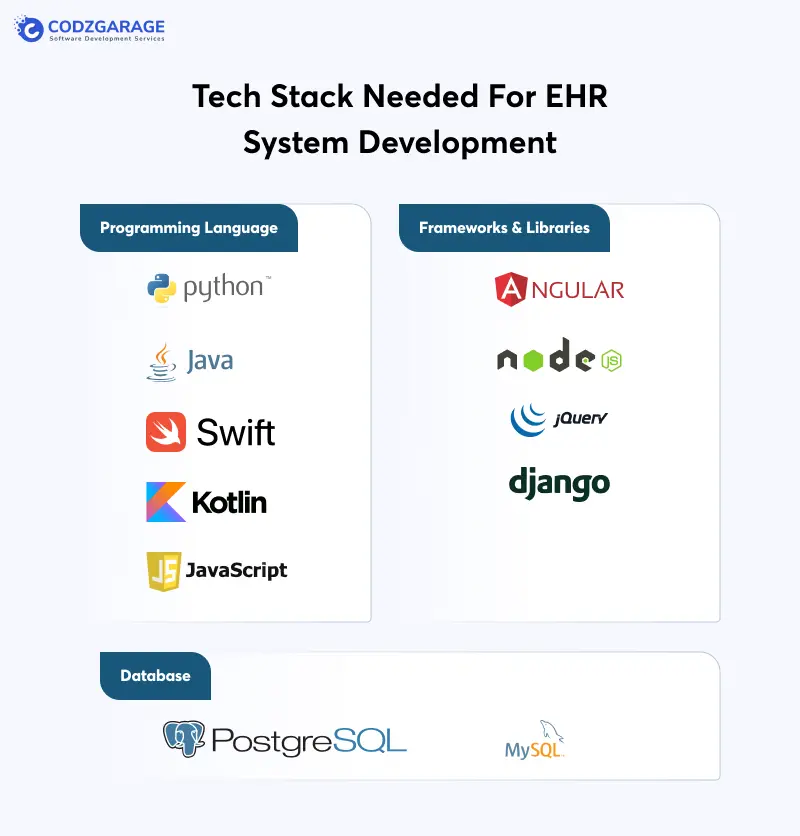
It would be best if you looked into the current healthcare app development trends & technologies before you embark on EHR system development. Because there’s no single ideal technology to employ for all projects, you should check what fits your needs well. Businesses are of different types, and so does their necessities. Hence, it’s completely upon the client and the developers to choose the technology they think is appropriate for them. Following are some of the technologies that you can choose from for your next project development.
Signing Off….!
That’s all about the EHR (electronic health record) management system! We discussed the topic comprehensively and gauged multiple factors like the EHR system, its kinds, features, benefits, and processes, as well as the technologies to build the same. Hopefully, most of your questions relating to the EHR software development have been answered; if you’re still feeling there’s something left unanswered, read onto the frequently asked questions given below so that you can get them all answered!
Frequently Asked Questions
However, there’s no certain cost to Electronic Health Record (EHR) software development; however, it can go anywhere between $40k to $100k. The development of EHR tends to vary depending on a variety of factors, including features you need, the tech stack & developers you choose, the complexity of your project and the like.
Both the EHR and EMR are aimed at simplifying and enhancing patient care while assisting physicians to save their precious time and enabling them to focus more on better patient care.
Yes, there are differences between EHR and EMR. A single provider controls and manages the EMR, while there are various providers to maintain the EHR system. Moreover, EHR offers detailed information as compared to EMRs and includes tools competent to enhance laboratory ordering, electronic processing and the like.
Yes, certain elements are the must-haves when it comes to EHR development. These are the availability of mobile versions, paper data migration, compliance readiness, and the like.
If you’ve an AI-powered EHR system, you’ll be able to enhance diagnosis, make it cost-effective while improving medical image assessments, and so on.

Need
to build EHR system?Our expertise!
- 11+ years of experience
- 100+ projects delivered
- High-end services
Related Blog

November 26, 2025
-
 1608
1608
 Kevin Bhut
 Since the concept of a “serverless” system is gaining traction, you’re likely to develop curiosity in this regard. But, it isn’t a big deal to understand the reasons for it. ...

June 23, 2025
-
1755
Paresh Kapuriya An informative guide letting you know how to handle hidden app development costs to circumvent budget overruns! ...
February 5, 2025
-
3973
Manthan Bhanvadiya Web application development has become a popular choice among organizations—as it assists them in saving their precious time and cost while improving the overall experience. ...
January 2, 2025
-
2654
Paresh Kapuriya Find the best software development practices to follow in 2025 to enhance your product quality and stay competitive in the marketplace. Explore More! ...
December 3, 2024
-
1895
Kevin Bhut Browse through this guide, containing everything you should know about software development automation, including its benefits, what to automate, the tools, etc....